Black Hole mystery: This time,Einstein might really be wrong!

Down this rabbit hole are many of the jazzy magical mysteries of modern
physics: Black holes. The shortcuts through space and time called
wormholes. Quantum entanglement, also known as spooky action at a
distance, in which particles separated by light-years can still
instantaneously appear to remain connected. The reward for going down
this hole could be a new understanding of why we think we live in a
universe with space and time at all, with suitably unpredictable
consequences. After all, if Einstein hadn't been troubled a century ago
by logical inconsistencies in the Newtonian universe, we might not have
GPS systems, which rely on his theory of general relativity to keep
time, in our pockets today.
Falling bodies
Black holes
are the most extreme predictions of Einstein's theory, which describes
how matter and energy warp the geometry of space and time the way a
heavy sleeper causes a mattress to sag. Too much matter and energy in
one place could cause space to sag so far that the matter inside it
would disappear as if behind a magician's cloak, collapsing endlessly to
a point of infinite density known as a singularity.
Einstein
thought that idea was ridiculous when it was pointed out to him at the
time, in 1916, but today astronomers agree that the universe is speckled
with such dark monsters, including beasts lurking in the hearts of most
galaxies that are millions and billions of time more massive than the
Sun. Many of them resulted from the collapse of dead stars.
General relativity is based on what Einstein later called his "happiest
thought," that a freely falling person would not feel his weight. It is
known simply as the equivalence principle; it says that empty space
looks the same everywhere and to everyone.
One consequence of
this principle is that an astronaut would not feel anything special
happening when he fell through the point of no return, known as the
event horizon, into a black hole. Like a bungee jumper, he would feel
weightless then and all the way until he hit the bottom, which could
take seconds or years depending on how big the hole was, and he would be
stretched like a noodle by tidal forces and then crushed into a speck.
At the event horizon there would be "no drama," in the lexicon — at
least in the physical sense, as opposed to the intellectual trauma of
knowing you were not ever going home. Things or people went in, they got
crushed to infinite density and disappeared. That was the traditional
view of black holes.
Things got more interesting, however, in
1974 when Stephen Hawking, the British cosmologist, stunned the world by
showing that when the paradoxical quantum laws that describe subatomic
behavior were taken into account, black holes would leak particles and
radiation, and in fact eventually explode, although for a hole the mass
of a star it would take longer than the age of the universe.
This was a breakthrough in combining general relativity, the gravity
that curves the cosmos, with quantum theory, which describes the
microscopic quirkiness inside it, but there was a big hitch. Dr Hawking
concluded that the radiation coming from a black hole would be
completely random, conveying no information about what had fallen into
it.
When the black hole finally exploded, all that information
would be erased from the universe forever. "God not only plays dice with
the universe," Dr Hawking said in 1976 in a riposte to Einstein's
famous doubts about the randomness of quantum theory, "he sometimes
throws them where they can't be seen."
Particle physicists
cried foul, saying that this violated a basic tenet of modern science
and of quantum theory, that information is always preserved. From the
material in the smoke and flames of a burning book, for example, one
could figure out whether it was the Bible or the Kama Sutra; the same
should be true of the fizz and pop of black holes, these physicists
argued. A 30-year controversy ensued.
It was front-page news in 2004 when Dr Hawking finally said that he had been wrong, and paid off a bet.
The firewall paradox
Now, however, some physicists say that Dr Hawking might have conceded
too soon. "He had good reason," said Dr Polchinski, "but he gave up for
the wrong reason." Nobody, he explained, had yet figured out exactly how
information does get out of a black hole.
That was the task
that four researchers based in Santa Barbara — Ahmed Almheiri, Donald
Marolf, and James Sully, all from the University of California, Santa
Barbara, and Dr Polchinski of the Kavli Institute set themselves a year
ago. The team (called AMPS, after their initials) found, to their
surprise, that following the known laws of physics would lead to a
contradiction, the firewall paradox.
Their calculations showed
that having information flowing out of a black hole was incompatible
with having an otherwise smooth Einsteinian space-time at its boundary,
the event horizon. In its place would be a discontinuity in the vacuum
that would manifest itself as energetic particles — a "firewall" — lurking just inside the black hole.
Being incinerated as you entered a black hole would certainly
contradict Einstein's dictum of no drama. If this were true, you would
in fact die long before the bungee-jumping ride ever got anywhere close
to the bottom. The existence of a firewall would mean that the horizon,
which according to general relativity is just empty space, is a special
place, pulling the rug out from under Einstein's principle, his theory
of gravity, and modern cosmology, which is based on general relativity.
This presented the scientists with what Dr Bousso calls the "menu from
hell." If the firewall argument was right, one of three ideas that lie
at the heart and soul of modern physics, had to be wrong. Either
information can be lost after all; Einstein's principle of equivalence
is wrong; or quantum field theory, which describes how elementary
particles and forces interact, is wrong and needs fixing. Abandoning any
one of these would be revolutionary or appalling or both.
Dr
Polchinski was very surprised by the result. "It seemed like such a
simple argument that it must have been considered and resolved earlier,"
he said. After trying to kill it by talking to colleagues in Santa
Barbara, he e-mailed Dr Susskind of Stanford, an old hand at black holes
and information, expecting that Dr Susskind would point out the error.
"But after a week or two of disbelief," Dr Polchinski said, "he was as confused as we" were.
Dr Susskind said: "The arguments are very clear. Nobody knew what to make of them."
Quantum vows
The firewall argument hinges on one of the weirder aspects of quantum
physics, the action called entanglement. As Einstein, Boris Podolsky and
Nathan Rosen pointed out in 1935, quantum theory predicts that a pair
of particles can be connected in such a way that measuring a property of
one — its direction of spin, say — will immediately affect the results
of measuring the other one, even if it is light-years away.
Einstein used this "spooky action at a distance" to suggest the
absurdity of quantum mechanics, but such experiments are now done in
labs every day. You can't use it to send a message faster than light,
because the correlation shows up only when the two experimenters get
together and compare their respective results. But it plays a crucial
role in quantum computing and cryptography — and, it turns out, in
explaining how information encoded in the Hawking radiation gets out of a
black hole.
Consider two particles (let's call them Bob and
Alice) that have been radiated by a black hole. Bob left it eons ago, as
it began leaking radiation; quantum entanglement theory dictates that
in order for the black hole to keep track of what information it has
been transmitting, Bob out there has to be entangled with Alice, who
just left.
But that scenario competes with another kind of
entanglement, between particles on either side of the event horizon, the
black hole's boundary. If space is indeed smooth, as Einstein
postulated, and if quantum field theory is correct, Alice must be
entangled with another particle, Ted, who is just inside the black hole.
But quantum theory forbids promiscuous entanglements. In the
language of quantum information, Alice can marry either Bob or Ted, but
not both, even if the second marriage happens inside the black hole
where most of us can't see it.
Alice should have a consistent
explanation of the universe, Dr Polchinski explained, "just as we
ourselves must, even though we are inside the cosmic horizon."
And so smoke pours from the AMPS group's computers and has continued to
pour from the particle accelerators of the mind, fueled by coffee and
blackboard chalk this last year. Firewall or not? Does information live
or die? Is Einstein at last wrong? Experiments would not help, even if
we had a black hole in a laboratory, because the putative firewall, if
it exists, would be just inside where it can't be seen safely.
At a firewall workshop this winter, John Preskill, a Caltech theorist
who won a bet with Dr Hawking on the randomness of information from a
black hole, declared that physicists were back where they had been 40
years ago.
The Menu From Hell
Dr
Bousso said his first response to the AMPS paper was, "Come on, you
gotta be kidding me." He added, "Everybody goes through their stages of
grief."
About 40 papers have been devoted to firewalls in the
last year, and more are on the way. Daniel Harlow of Princeton and
Patrick Hayden of McGill University suggested that the issue might be
moot; the computation necessary to verify that Alice and Bob are
entangled could take longer than the age of the universe and the black
hole would evaporate in the meantime, making it impossible ever to go
inside and experience the contradiction.
Failing that, which of the items on Dr Bousso's "menu from hell" might have to go depends on who is speaking.
In some ways, it would be easiest to give up quantum field theory,
which describes what empty space should look like, in the case of
someone who is being accelerated, perhaps by gravity pulling him down a
black hole. After all, quantum theory, with "virtual" particles flitting
in and out of existence and spooky entanglements is already strange. On
the other hand, as Ed Witten of the Institute for Advanced Study, who
has so far watched the firewall debate from a distance, said, "Quantum
field theory is how the world works." It had a major triumph just a year
ago, when the Higgs boson, a subatomic particle responsible for the
mass of other subatomic particles, was discovered after a 40-year
search, at the Large Hadron Collider at CERN.
Meanwhile,
physicists have more reason than ever to think that information cannot
be lost. A celebrated 1997 paper by Juan M. Maldacena of the Institute
for Advanced Study describes nature as a kind of hologram, in which the
information about what happens inside a volume of three-dimensional
space, for example, is encoded in quantum equations on its
two-dimensional boundary, the way a 3-D image is encoded on the face of
your bank card.
Mark Van Raamsdonk, a young theorist at the
University of British Columbia, likes to use a spookier analogy to
describe this, namely the chip that controls a Matrix-like video game.
(Feel free to insert your own woo-woo music here.)
The
discovery that the information needed to describe what happens in some
volume is proportional to the area enclosing that volume is the
strangest and most far-reaching consequence of Dr Hawking's discovery
that black holes explode, and is still wreathed in mystery.
Dr
Maldacena's universe is often portrayed like a can of soup, in which
galaxies, black holes, gravity, stars and so forth, including us, are
the soup inside, while the information to describe them resides, like a
label, on the outside. Think of it as gravity in a can. The equations
that represent the label are deterministic and there is no room in them
for information to be lost, implying that information in the universe
inside is also preserved.
Which leaves the firewall as the only
way to stop the illegal marriage of Alice and Ted, Dr Polchinski said —
an odious solution because it contravenes the basic principle of
general relativity.
He pointed out, however, that in a sense
physicists had already thrown Einstein under the bus. In Dr Maldacena's
holographic universe, considered to be the last word on quantum gravity,
the dimensions of space-time do not seem to matter. "We've known for
years that space-time is not fundamental," Dr Polchinski said. "General
relativity is not fundamental."
He went on, "space-time is emergent. Gravity is emergent. Maybe sometimes it doesn't always emerge."
Einstein's revenge
But if space and time and gravity are not fundamental, what is?
Recently a new way of solving the firewall conundrum and of answering
that haunting question has attracted a lot of attention, although no
consensus. Dr Maldacena and Dr Susskind have proposed that Einstein
could come to his own rescue via one more far-out notion in modern
physics: wormholes.
In 1935 Einstein and Rosen found that,
mathematically anyway, black holes could come in pairs connected by
shortcuts through space — then known as Einstein-Rosen bridges, now
known as wormholes. A wormhole would not be traversable by any means we
now know about, ruling out time travel and other violations of
relativity, despite the dreams of science fiction writers and
interstellar pioneers.
In 2010, Dr Van Raamsdonk of British
Columbia suggested that such wormholes were the geometric manifestations
of quantum entanglement. After all, neither of these phenomena, which
seemed to transcend local space, could be used for sending direct
messages. Brian Swingle at MIT had made a similar suggestion a year
earlier.
In effect, what these theorists were saying was that
without the phenomenon of entanglement, space-time would have no
structure at all. Or as Dr Maldacena put it, "Spooky action at a
distance creates space-time." If true, this insight would be a step
toward a longtime dream of theorists of explaining how space and time
emerge from some more basic property of reality, in this case, bits of
quantum information. The theorist John Wheeler, of Princeton, who had
coined the term "black hole," called this concept "it from bit."
Taking this idea seriously, Dr Maldacena and Dr Susskind proposed that a
similar kind of wormhole arrangement existed between the black hole in
the AMPS case and its Hawking radiation. Instead of a tunnel snaking
through hyperspace and opening at the maw of another black hole, the
wormhole would split into a zillion spaghetti-like strands ending on
each of the pieces of Hawking radiation. That would mean that Bob, the
Hawking particle in the cartoon version of the theory mentioned above,
might be light years away from the event horizon, but he would still be
connected to the interior of the black hole, as if there were a doorway
in New Jersey that opened up into a basement in Manhattan.
Because of this wormhole connection, Dr Maldacena explained, "Ted and
Bob are the same." So the result is sort of like the happy ending of one
of those screwball romantic comedies that involve mistaken identity and
the handsome vagabond turns out to be the prince in disguise; Alice can
marry Ted who is really Bob and the bonds of matrimony extend smoothly
across the edge of the black hole.
In that case, then, there is no firewall, no contradiction in the laws of physics. And Einstein survives to fight another day.
"If right, this is clearly a major insight into gravity and quantum
mechanics," an enthusiastic Dr Susskind said. "I think of it as a very
dramatic thing," he said, noting that long after Einstein's career was
presumed to be over, at 56, "he produced these ideas" of entanglement
and wormholes having no idea they were connected.
"The man keeps giving."
But Einstein is not safe yet.
"At first whiff," Dr Preskill wrote in a recent blog post, the
Maldacena-Susskind conjecture "may smell fresh and sweet, but it will
have to ripen on the shelf for a while." He added, "For now, wormhole
lovers can relish the possibilities."
Entangled Theories
Dr Maldacena and Dr Susskind admit that the wormhole hypothesis is
still a work in progress. Few of their colleagues are convinced yet that
it has been formulated in sufficient detail, let alone that it can
solve the firewall paradox. "All I can say," Dr Susskind said in an
e-mail on the eve of a firewall workshop next week at the Kavli
Institute where wormholes and everything else will surely be
scrutinized, "is that no one has a completely solid case and that
certainly includes me. Time will tell."
Dr Polchinski said, "My
current thinking is that all the arguments that we are having are the
kind of arguments that you make when you don't have a theory." We need a
more complete theory of gravity, he concluded.
"Maybe 'space-time from entanglement' is the right place to start," he wrote. "I am not sure."
Dr Bousso, who has been e-mailing with Dr Maldacena, is skeptical that
the wormholes will eliminate firewalls. "My own view is that it's time
to move on, accept, and actually understand firewalls," he said. After
all, he added, there's no principle of nonviolence in the universe,
except for Einstein's equivalence principle, which says the black hole's
horizon is not a special place. But maybe it is, after all.
Meanwhile, Dr Bousso said, the present debate had raised his estimation,
"by another few notches," of the "stupendous magnitude" of Dr Hawking's
original discovery of the information paradox.
The firewall
paradox," he said, "tells us that the conceptual cost of getting
information back out of a black hole is even more revolutionary than
most of us had believed."
HOW SMART ARE THESE SMART PHONES MAKING OUR CHILDREN?
Falling bodies
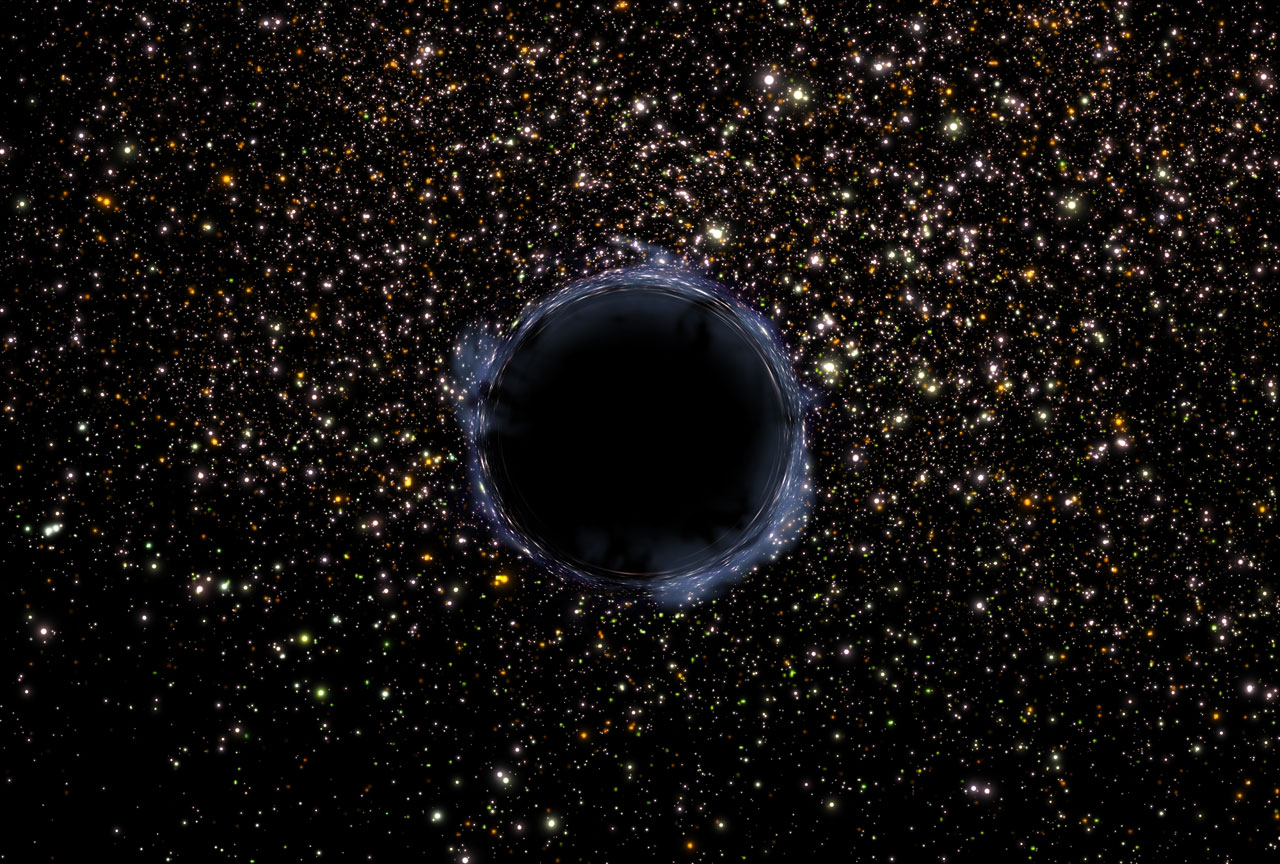
Black holes are the most extreme predictions of Einstein's theory, which describes how matter and energy warp the geometry of space and time the way a heavy sleeper causes a mattress to sag. Too much matter and energy in one place could cause space to sag so far that the matter inside it would disappear as if behind a magician's cloak, collapsing endlessly to a point of infinite density known as a singularity.
Einstein thought that idea was ridiculous when it was pointed out to him at the time, in 1916, but today astronomers agree that the universe is speckled with such dark monsters, including beasts lurking in the hearts of most galaxies that are millions and billions of time more massive than the Sun. Many of them resulted from the collapse of dead stars.
General relativity is based on what Einstein later called his "happiest thought," that a freely falling person would not feel his weight. It is known simply as the equivalence principle; it says that empty space looks the same everywhere and to everyone.
One consequence of this principle is that an astronaut would not feel anything special happening when he fell through the point of no return, known as the event horizon, into a black hole. Like a bungee jumper, he would feel weightless then and all the way until he hit the bottom, which could take seconds or years depending on how big the hole was, and he would be stretched like a noodle by tidal forces and then crushed into a speck.
At the event horizon there would be "no drama," in the lexicon — at least in the physical sense, as opposed to the intellectual trauma of knowing you were not ever going home. Things or people went in, they got crushed to infinite density and disappeared. That was the traditional view of black holes.
Things got more interesting, however, in 1974 when Stephen Hawking, the British cosmologist, stunned the world by showing that when the paradoxical quantum laws that describe subatomic behavior were taken into account, black holes would leak particles and radiation, and in fact eventually explode, although for a hole the mass of a star it would take longer than the age of the universe.
This was a breakthrough in combining general relativity, the gravity that curves the cosmos, with quantum theory, which describes the microscopic quirkiness inside it, but there was a big hitch. Dr Hawking concluded that the radiation coming from a black hole would be completely random, conveying no information about what had fallen into it.
When the black hole finally exploded, all that information would be erased from the universe forever. "God not only plays dice with the universe," Dr Hawking said in 1976 in a riposte to Einstein's famous doubts about the randomness of quantum theory, "he sometimes throws them where they can't be seen."
Particle physicists cried foul, saying that this violated a basic tenet of modern science and of quantum theory, that information is always preserved. From the material in the smoke and flames of a burning book, for example, one could figure out whether it was the Bible or the Kama Sutra; the same should be true of the fizz and pop of black holes, these physicists argued. A 30-year controversy ensued.
It was front-page news in 2004 when Dr Hawking finally said that he had been wrong, and paid off a bet.
The firewall paradox
Now, however, some physicists say that Dr Hawking might have conceded too soon. "He had good reason," said Dr Polchinski, "but he gave up for the wrong reason." Nobody, he explained, had yet figured out exactly how information does get out of a black hole.
That was the task that four researchers based in Santa Barbara — Ahmed Almheiri, Donald Marolf, and James Sully, all from the University of California, Santa Barbara, and Dr Polchinski of the Kavli Institute set themselves a year ago. The team (called AMPS, after their initials) found, to their surprise, that following the known laws of physics would lead to a contradiction, the firewall paradox.
Their calculations showed that having information flowing out of a black hole was incompatible with having an otherwise smooth Einsteinian space-time at its boundary, the event horizon. In its place would be a discontinuity in the vacuum that would manifest itself as energetic particles — a "firewall" — lurking just inside the black hole.
Being incinerated as you entered a black hole would certainly contradict Einstein's dictum of no drama. If this were true, you would in fact die long before the bungee-jumping ride ever got anywhere close to the bottom. The existence of a firewall would mean that the horizon, which according to general relativity is just empty space, is a special place, pulling the rug out from under Einstein's principle, his theory of gravity, and modern cosmology, which is based on general relativity. This presented the scientists with what Dr Bousso calls the "menu from hell." If the firewall argument was right, one of three ideas that lie at the heart and soul of modern physics, had to be wrong. Either information can be lost after all; Einstein's principle of equivalence is wrong; or quantum field theory, which describes how elementary particles and forces interact, is wrong and needs fixing. Abandoning any one of these would be revolutionary or appalling or both.
Dr Polchinski was very surprised by the result. "It seemed like such a simple argument that it must have been considered and resolved earlier," he said. After trying to kill it by talking to colleagues in Santa Barbara, he e-mailed Dr Susskind of Stanford, an old hand at black holes and information, expecting that Dr Susskind would point out the error.
"But after a week or two of disbelief," Dr Polchinski said, "he was as confused as we" were.
Dr Susskind said: "The arguments are very clear. Nobody knew what to make of them."
Quantum vows
The firewall argument hinges on one of the weirder aspects of quantum physics, the action called entanglement. As Einstein, Boris Podolsky and Nathan Rosen pointed out in 1935, quantum theory predicts that a pair of particles can be connected in such a way that measuring a property of one — its direction of spin, say — will immediately affect the results of measuring the other one, even if it is light-years away.
Einstein used this "spooky action at a distance" to suggest the absurdity of quantum mechanics, but such experiments are now done in labs every day. You can't use it to send a message faster than light, because the correlation shows up only when the two experimenters get together and compare their respective results. But it plays a crucial role in quantum computing and cryptography — and, it turns out, in explaining how information encoded in the Hawking radiation gets out of a black hole.
Consider two particles (let's call them Bob and Alice) that have been radiated by a black hole. Bob left it eons ago, as it began leaking radiation; quantum entanglement theory dictates that in order for the black hole to keep track of what information it has been transmitting, Bob out there has to be entangled with Alice, who just left.
But that scenario competes with another kind of entanglement, between particles on either side of the event horizon, the black hole's boundary. If space is indeed smooth, as Einstein postulated, and if quantum field theory is correct, Alice must be entangled with another particle, Ted, who is just inside the black hole.
But quantum theory forbids promiscuous entanglements. In the language of quantum information, Alice can marry either Bob or Ted, but not both, even if the second marriage happens inside the black hole where most of us can't see it.
Alice should have a consistent explanation of the universe, Dr Polchinski explained, "just as we ourselves must, even though we are inside the cosmic horizon."
And so smoke pours from the AMPS group's computers and has continued to pour from the particle accelerators of the mind, fueled by coffee and blackboard chalk this last year. Firewall or not? Does information live or die? Is Einstein at last wrong? Experiments would not help, even if we had a black hole in a laboratory, because the putative firewall, if it exists, would be just inside where it can't be seen safely.
At a firewall workshop this winter, John Preskill, a Caltech theorist who won a bet with Dr Hawking on the randomness of information from a black hole, declared that physicists were back where they had been 40 years ago.
The Menu From Hell
Dr Bousso said his first response to the AMPS paper was, "Come on, you gotta be kidding me." He added, "Everybody goes through their stages of grief."
About 40 papers have been devoted to firewalls in the last year, and more are on the way. Daniel Harlow of Princeton and Patrick Hayden of McGill University suggested that the issue might be moot; the computation necessary to verify that Alice and Bob are entangled could take longer than the age of the universe and the black hole would evaporate in the meantime, making it impossible ever to go inside and experience the contradiction.
Failing that, which of the items on Dr Bousso's "menu from hell" might have to go depends on who is speaking.
In some ways, it would be easiest to give up quantum field theory, which describes what empty space should look like, in the case of someone who is being accelerated, perhaps by gravity pulling him down a black hole. After all, quantum theory, with "virtual" particles flitting in and out of existence and spooky entanglements is already strange. On the other hand, as Ed Witten of the Institute for Advanced Study, who has so far watched the firewall debate from a distance, said, "Quantum field theory is how the world works." It had a major triumph just a year ago, when the Higgs boson, a subatomic particle responsible for the mass of other subatomic particles, was discovered after a 40-year search, at the Large Hadron Collider at CERN.
Meanwhile, physicists have more reason than ever to think that information cannot be lost. A celebrated 1997 paper by Juan M. Maldacena of the Institute for Advanced Study describes nature as a kind of hologram, in which the information about what happens inside a volume of three-dimensional space, for example, is encoded in quantum equations on its two-dimensional boundary, the way a 3-D image is encoded on the face of your bank card.
Mark Van Raamsdonk, a young theorist at the University of British Columbia, likes to use a spookier analogy to describe this, namely the chip that controls a Matrix-like video game. (Feel free to insert your own woo-woo music here.)
The discovery that the information needed to describe what happens in some volume is proportional to the area enclosing that volume is the strangest and most far-reaching consequence of Dr Hawking's discovery that black holes explode, and is still wreathed in mystery.
Dr Maldacena's universe is often portrayed like a can of soup, in which galaxies, black holes, gravity, stars and so forth, including us, are the soup inside, while the information to describe them resides, like a label, on the outside. Think of it as gravity in a can. The equations that represent the label are deterministic and there is no room in them for information to be lost, implying that information in the universe inside is also preserved.
Which leaves the firewall as the only way to stop the illegal marriage of Alice and Ted, Dr Polchinski said — an odious solution because it contravenes the basic principle of general relativity.
He pointed out, however, that in a sense physicists had already thrown Einstein under the bus. In Dr Maldacena's holographic universe, considered to be the last word on quantum gravity, the dimensions of space-time do not seem to matter. "We've known for years that space-time is not fundamental," Dr Polchinski said. "General relativity is not fundamental."
He went on, "space-time is emergent. Gravity is emergent. Maybe sometimes it doesn't always emerge."
Einstein's revenge
But if space and time and gravity are not fundamental, what is?
Recently a new way of solving the firewall conundrum and of answering that haunting question has attracted a lot of attention, although no consensus. Dr Maldacena and Dr Susskind have proposed that Einstein could come to his own rescue via one more far-out notion in modern physics: wormholes.
In 1935 Einstein and Rosen found that, mathematically anyway, black holes could come in pairs connected by shortcuts through space — then known as Einstein-Rosen bridges, now known as wormholes. A wormhole would not be traversable by any means we now know about, ruling out time travel and other violations of relativity, despite the dreams of science fiction writers and interstellar pioneers.
In 2010, Dr Van Raamsdonk of British Columbia suggested that such wormholes were the geometric manifestations of quantum entanglement. After all, neither of these phenomena, which seemed to transcend local space, could be used for sending direct messages. Brian Swingle at MIT had made a similar suggestion a year earlier.
In effect, what these theorists were saying was that without the phenomenon of entanglement, space-time would have no structure at all. Or as Dr Maldacena put it, "Spooky action at a distance creates space-time." If true, this insight would be a step toward a longtime dream of theorists of explaining how space and time emerge from some more basic property of reality, in this case, bits of quantum information. The theorist John Wheeler, of Princeton, who had coined the term "black hole," called this concept "it from bit."
Taking this idea seriously, Dr Maldacena and Dr Susskind proposed that a similar kind of wormhole arrangement existed between the black hole in the AMPS case and its Hawking radiation. Instead of a tunnel snaking through hyperspace and opening at the maw of another black hole, the wormhole would split into a zillion spaghetti-like strands ending on each of the pieces of Hawking radiation. That would mean that Bob, the Hawking particle in the cartoon version of the theory mentioned above, might be light years away from the event horizon, but he would still be connected to the interior of the black hole, as if there were a doorway in New Jersey that opened up into a basement in Manhattan.
Because of this wormhole connection, Dr Maldacena explained, "Ted and Bob are the same." So the result is sort of like the happy ending of one of those screwball romantic comedies that involve mistaken identity and the handsome vagabond turns out to be the prince in disguise; Alice can marry Ted who is really Bob and the bonds of matrimony extend smoothly across the edge of the black hole.
In that case, then, there is no firewall, no contradiction in the laws of physics. And Einstein survives to fight another day.
"If right, this is clearly a major insight into gravity and quantum mechanics," an enthusiastic Dr Susskind said. "I think of it as a very dramatic thing," he said, noting that long after Einstein's career was presumed to be over, at 56, "he produced these ideas" of entanglement and wormholes having no idea they were connected.
"The man keeps giving."
But Einstein is not safe yet.
"At first whiff," Dr Preskill wrote in a recent blog post, the Maldacena-Susskind conjecture "may smell fresh and sweet, but it will have to ripen on the shelf for a while." He added, "For now, wormhole lovers can relish the possibilities."
Entangled Theories
Dr Maldacena and Dr Susskind admit that the wormhole hypothesis is still a work in progress. Few of their colleagues are convinced yet that it has been formulated in sufficient detail, let alone that it can solve the firewall paradox. "All I can say," Dr Susskind said in an e-mail on the eve of a firewall workshop next week at the Kavli Institute where wormholes and everything else will surely be scrutinized, "is that no one has a completely solid case and that certainly includes me. Time will tell."
Dr Polchinski said, "My current thinking is that all the arguments that we are having are the kind of arguments that you make when you don't have a theory." We need a more complete theory of gravity, he concluded.
"Maybe 'space-time from entanglement' is the right place to start," he wrote. "I am not sure."
Dr Bousso, who has been e-mailing with Dr Maldacena, is skeptical that the wormholes will eliminate firewalls. "My own view is that it's time to move on, accept, and actually understand firewalls," he said. After all, he added, there's no principle of nonviolence in the universe, except for Einstein's equivalence principle, which says the black hole's horizon is not a special place. But maybe it is, after all.
Meanwhile, Dr Bousso said, the present debate had raised his estimation, "by another few notches," of the "stupendous magnitude" of Dr Hawking's original discovery of the information paradox.
The firewall paradox," he said, "tells us that the conceptual cost of getting information back out of a black hole is even more revolutionary than most of us had believed."

Ask an old-timer what website they’d use to stream videos or even who their ISP is and they’d look at you with blank stare. Ask them to tie their shoe, however, and they’d share stories of their first time ever tying their shoes. This, according to AVG (Internet Security Company), doesn’t apply to today’s youth.
A recent poll was done to 2,200 moms that have internet access and have children between 2-5 in major countries and continents in the world. These statistics are rather surprising.
From AVG’s press releaseI’m actually surprised that i’m not really surprised from what they’ve discovered. The shift our world is making from analog to digital is arriving faster than I could’ve ever expected. I guarantee that there’s a multi-touch capable app that allows you to use two fingers to teach a person how to tie a shoe. Soon, smart phones are going to completely replace a parent’s role in a child’s life. Is this what we really want? Because it’s where we’re headed.
1 – More small children can play a computer game than ride a bike. 58 percent of children aged 2-5 know how to play a ‘basic’ computer game. For the U.K. and France that jumps to 70 percent. Even 44 percent of 2-3 year olds have the ability to play a computer game. By comparison, 43 percent of kids 2-3 can ride a bike
2 – More kids aged 2-5 can play with a smartphone application (19 percent) than tie his or her shoelaces (9 percent). Almost as many 2-3 year olds (17 percent) can play with a smartphone application as 4-5 year olds (21 percent)
3 – More small children can open a web browser (25 percent) than swim unaided (20 percent)
4 – There is no tech gender divide between young boys and girls. As many boys as girls can play a computer game or make a mobile phone call (28 percent boys, 29 percent girls)
5 – Mothers aged 35 and over are slightly better at teaching their kids ‘life skills.’ For example 40 percent of toddlers with mothers aged 35-plus can write their own name compared with 35 percent of toddlers with mothers aged 34 or younger
6 – European children aged 2-5 lead their U.S. counterparts in knowing how to make a mobile phone call (44 percent in Italy vs. 25 percent for the U.S.), playing a computer game (70 percent U.K. vs. 61 percent U.S.) and operating a computer mouse (78 percent France vs. 67 percent U.S.)
How To Get Rid Of Pimples Overnight ,For That Flawless Skin
It is true treating pimples needs both patience and persistence, but sometimes time is the thing you are short of. You desperately need them off your face at any cost; the world seems almost cruel otherwise. You almost feel like tearing your hair out thinking of how to get rid of pimples overnight and it is for situations like these that there are over the counter drugs and ointments.
However, just using medicines will not relieve you of the pimples, there are rules you have to follow to make it work out right. There are Dos and Do nots and always remember some things are better left alone, messing with them is not advisable. For example, if you think the easiest way out of your ordeal would be to pop your zits, you are definitely wrong.
Most of the time, overnight pimple cures are just an overblown phrase because an overnight cure for pimples is almost impossible to devise without a change in your lifestyle. Especially if you are used to having a stressful life and you have a biased diet. Try to make it a balanced one including food that would also make it into a cleansing diet. Talking of cleansing, there is no substitute for water, thus make drinking 8-10 glasses of water each day a part of your daily routine.
Tips for overnight cure
Some home remedies however can rid you of pimples sometimes overnight and even if not overnight by not more than half a day.
You could use the white of an egg to dab on your pimple. Once left on for around 20 minutes it usually helps and dries up the pimple. Another unique method would be to apply toothpaste; preferably not the gel type on the pimple and it has the same effect.
Cleaning the skin is an essential part of curing pimples and the cleaning needs special care when you need to cure pimples overnight. If you wash your face with a soap enriched with aloe vera it can help you immensely. You could also try cleaning your skin with apple cider vinegar, or a more simple remedy would be to clean it with lemon juice.
Before you start any pimple remedy, you must be sure that the acne is not caused due to an allergic reaction to any food or cosmetics. The cure could otherwise have an adverse effect on the acne.
Your skin is unique and different from everyone else's and therefore you should remember that what works for someone else might not work for you and vice versa.Both the doctor and the dermatologist might have ideas that would truly rid you of that pimple overnight.
Birthday Gift Ideas For Your Boyfriend
Whether you and your boyfriend have been dating for three months or three years, he deserves to have a wonderful present from you whenever he celebrates his birthday.
Well-thought out gifts are always a great way to show your affection and love for your boyfriend. Some men may not be as open emotionally as women, but your boyfriend surely could not resist giving you a kiss or a hug in exchange of all the time and effort that you put into finding the perfect birthday present for him.
Here are some great and romantic gift ideas to give the most special man in your life on his birthday:
1. Something romantic.
A birthday present does not always have to be something expensive. Be creative in thinking of a romantic birthday gift for your boyfriend. If he has always given you flowers before, why don't you return the favor by giving him a dozen red roses? It will make him remember you as the only girl who ever gave him roses for his birthday.
A little effort would go a long way, too. Cook him his favorite dish and invite him over for a romantic picnic or dinner. Bake him a birthday cake, invite his friends over and surprise him with a birthday party.
Shower him with love notes, or make his entire day special by giving him a different gift in the morning, noon and at night. Be creative in thinking of something fun, romantic and special to give him a birthday that he is not likely to forget.
2. Something that he wants.
If your special someone is into gadgets, give him that game gadget or music player that he is always talking about. If he is a car enthusiast, get him a great car accessory. Or, rent a sports vehicle or his dream car for him to drive on his birthday. Go out and spend a day indulging in the sport that he just loves.
3. Something naughty.
Glow-in-the-dark boxer shorts are a sure-fire way to tickle his fancy. An intimate yet funny gift will remind him of the intimate moments that you shared together as a couple.
4. Something nice and traditional.
A basketful of chocolates or wine is a wonderful birthday present.
If he is an executive, get him an expensive tie, cute cuff links or a nice wristwatch. Give him a set of his favorite cologne, perfume and aftershave. If he loves sailing, get him an antique compass that he can use.
5. Something that says "I love you."
You can literally give him an item with the message of how you feel. Give him a keychain for his car and house keys with an engraved message. Even small items like this would make your boyfriend feel special.
Remember that it is not always the cost that counts when giving out presents for your boyfriend on his birthday.
A well-thought out gift that would remind your boyfriend of how special he is to you will send out the right message on his birthday.

No comments:
Post a Comment